
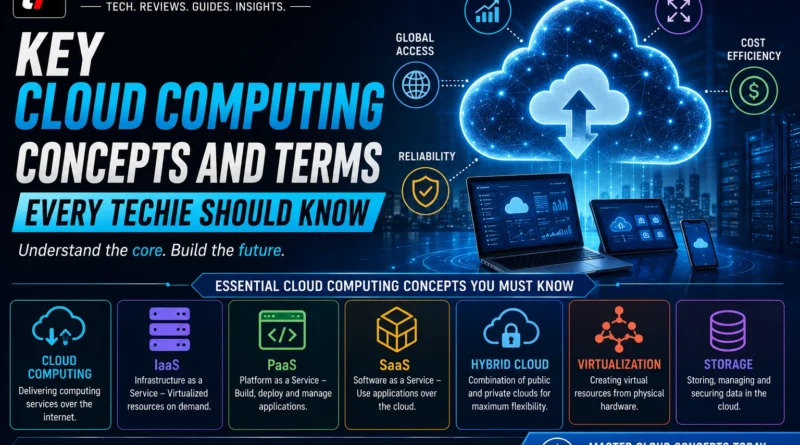
Key cloud Computing Concepts and Terms Every Techie Should Know
Introduction
Cloud computing is at the core of the modern digital world. Whether you’re using a Google Drive, streaming on Netflix or managing business operations via Salesforce, cloud technologies are behind it all. But with all its benefits, cloud computing also introduces a wide range of technical jargon that can be overwhelming the beginners. Understanding the key cloud computing concepts and essential cloud computing terms is no longer optional even it’s career necessity.
In this blog post, we’ll break down essential cloud computing concepts and terms in a human-readable way to help you understand this technology better.
Core Cloud Computing Concepts
Cloud Computing
Delivery of IT resources on demand, like servers, storage, applications, databases, etc., over the internet.
On-Demand Self-Service
Users manage the resources themselves through the portal without the interaction of the cloud provider.
Pay as you go
Users only pay for the resources they consume. This allows them cost optimization and scalability.
Cloud Provider
It is a company that provides cloud computing services such as Google Cloud, Microsoft Azure and Amazon Web Services (AWS).
Cloud Storage
Stores data on remote servers accessible over the internet, such as Google Drive and Dropbox.
Cloud Infrastructure
The software and hardware components that support cloud services such as servers, networking, storage, applications, databases and virtualization.
Cloud Migration
The process of shifting data, applications and other IT resources from an on-premises server to the cloud.
Cluster
A group of computers or hosts that work together for a specific purpose applications or software. In a cluster individual host is called a node and all nodes work collectively on the same tasks. A cluster is used for high-performance applications that require significant computing power.
Compute
Compute is refer to computational activities that require processing resources. Organizations should be aware of their existing computing capacity and computing power to support their critical business activities.
Containers
Containers are software units that help organizations to run their applications quickly and reliably in different computing environments but using the same computing resources. Containers group all components, including code, system libraries and settings in lightweight and secure packages to run the application quickly. Containers can be deployed easily and consistently everywhere.
Important Cloud Computing Terms and Definitions
Content Delivery Network (CDN)
A content delivery network (CDN) is a group of geographically distributed servers that collaboratively work to deliver content on the web. CDNs help organizations to rapidly transfer their assets such as HTML pages, images, videos and style sheets to end users. In today’s world, CDNs are delivering a vast majority of web content.
Cloud Economics
Cloud economics help to understand the financial impact of cloud computing, including legacy hardware investments, the monthly budget of cloud computing and savings due to better policy and technical innovations. This helps an organization to assess its situation in the right way.
Cloud Cost Management
Cloud cost management is also known as cloud cost optimization, helps organizations in planning their cloud resources. Allowing them to understand and manage the cost and need of their technology assets. Particularly, this means finding cost-effective ways to maximize cloud usage and efficiency.
Cloud Optimization
Cloud optimization is the process of managing and choosing the right cloud resources according to need. It helps to minimize cost, improve performance and efficiency and aligns resources with workload demands, identifying and eliminating waste.
Cloud Native
Cloud native is a software development approach used to build and run applications with in cloud environments. It uses technologies as micro services, containers and container orchestration to create resilient, scalable and manageable applications. These applications utilize the on-demand computing power and automated scalability features.
Cloud Management Platform (CMP)
CMP is a suite of integrated software tools that helps organizations to manage, optimize and monitor their cloud environments, including private, public and hybrid clouds. CMP provides a centralized interface for control and visibility of cloud resources such as services and workloads, regardless of the hosted location.
Virtual Desktop Infrastructure
Virtual desktop infrastructure, shortly called VDI, is an IT infrastructure that centralizes the desktop environments on a central server. It allows users to access their virtual desktops from different devices. VDI facilitates users to run applications and desktop operating systems within the virtual machines on the server and access them from anywhere remotely through a network connection.
Data Architecture
Data architecture is a framework that helps an organization to manage its data, storage, distribution and use. Its primary function is to control data within the organization by ensuring its accuracy, accessibility and security.
Data Lake
A Data Lake is a centralized repository that is used to store large volumes of data in its original format. It can store both structured and unstructured data. It is capable of storing data from on-premises and real-time streams. It makes it flexible and scalable to a vast range of data types and analytics.
Data Migration
Data migration is a process of moving data from on-premises to virtual environments or From one type of storage to another. Mostly, data migration is done due to changes of infrastructure, which is more reliable than the current infrastructure. The main purpose of data migration is to increase the security of data, performance and efficiency. Nowadays, organizations migrate data from on-premises to cloud as Google Cloud, Azure, or AWS.
Edge Data
Edge data is a distributed computational model that brings computation and data storage close to the location physically, rather than a centralized cloud or data center. This helps to reduce latency, improve response time and network efficiency.
Elastic Computing
Elastic computing is also known as cloud elasticity. This is the capability of a cloud computing system to automatically adjust its resources as storage, memory and computing power, up or down to meet the demand in peak and in normal times. This dynamic scaling ensures cost efficiency and performance by allocating the resources at the right time.
Extract, Transform and Load (ETL)
Extract, transform, and load, shortly called ETL, is the process of data integration. It retrieves data from different sources and cleans, transforms and formats it then loads it to the target system as a data warehouse. This process is used for data warehousing, data analytics and intelligence.
High Availability (HA)
High availability (HA) helps systems to remain up and working with minor downtime. It ensures continuity of service in case of failure or disruptions and eliminates a single point of failure.
Hosted Applications
Hosted applications that run on a remote server and are managed by a third-party provider. It is accessed through the internet. This is different from locally installed applications in the user’s system.
Load Balancing
Load balancing is a very important technique used to distribute resources evenly on multiple hosts in a cloud computing environment. In this way, it optimizes the performance, cost and availability and prevents a single point of failure, slowness and even a bottleneck.
Multi-tenant
Multi-tenant architecture, also known as multitenancy, is a software architecture in cloud computing that allows multiple instances of an application from single host. By multitenancy, organizations serve multiple customers securely from a single host via independent instances.
Scalability
Scalability is a feature of cloud computing and has the ability to increase or decrease the computing power as per the requirements of the situation. This can add more resources (scaling out) or can increase the capacity of existing resources (scaling up).
IAM (Identity and Access Management)
IAM refers to who is authorized to log in and what resources they can access. IAM works as a security guard who ensures access for authorized individuals, controls unauthorized access and prevents data breaches.
Serverless Computing
Serverless computing is a cloud computing process model that allows developers to build and run applications without managing any servers. It provides ease to developers to just focus on writing code and deploying the application without managing any infrastructure.
Final Thoughts
Mastering the key cloud computing concepts and understanding essential cloud computing terms is critical for anyone pursuing a career in modern IT. From SaaS, PaaS, and IaaS to virtualization and hybrid deployment models, these cloud computing fundamentals form the backbone of today’s digital infrastructure.
Whether you’re a developer, system administrator, or tech enthusiast, building a strong foundation in this cloud computing glossary equips you to adapt to rapid industry changes and leverage emerging technologies. By staying fluent in cloud technology terminology, you’ll be ready to design, manage, and optimize solutions that power businesses worldwide.
In short, knowing these cloud computing basics for techies isn’t just an advantage—it’s essential for advancing your career and thriving in the ever-evolving world of cloud technology.
sry0kd